Saturday, October 24, 2015

Are Trangender people God's Mistake?

I was Transsexual .Then Jesus came into my life

God doesn’t create a person with the genitals of a male and the consciousness and heart of a female.

His wonderful work leaves no room for mistakes; no one is born with the “wrong body.”

Sometimes the evangelical tribe says that trans-gender people can't exist; that those who say so are confused or have a disorder of some kind. 

I'm sometimes taken aback by how pervasive groupthink is, how it leaves us with the inability to entertain counter-arguments. Sometimes exposure to this kind of groupthink leaves others thinking that they're just stupid, rather than the truth that like most of us, they're not very good at practicing intellectual discipline when we're surrounded by people who hold the same beliefs that they do.

In the case of evangelicals protesting transgenderism because, "God doesn't make mistakes", the counter should be clear. There are tons of wrong things we are born with that we should fix if we are able:

-When a baby is born with one leg, we don't say, "God doesn't make mistakes, he can't have an artificial leg"

-When a baby is born not breathing we don't say, "God doesn't make mistakes, we can't give CPR"

-When a baby is born identifying intellectually as one gender and identifying bodily as the other gender...

This is one aspect of a broader trend in evangelicals to ignore natural evil completely. They, like the world that they're not supposed to conform to, believe that nature is perfect and all the terribleness in our experience can be traced naturally to human beings messing with things.

This is false. Nature is a mess; red in tooth and claw. The Problem of Natural Evil, is called a problem for a reason. And whatever solution the theist might have for it should be applies consistently. When someone says they were born transgender, you should not forget the reality of natural evil as an explanation and surgery or hormone pills a solution, no different from the many problems in nature and many solutions we've come up with.

Tuesday, October 6, 2015

How Speculation Works and why the Prophets don't Speculate

There's nothing novel about what David Friedman believes about speculation, economists everywhere would give him a thumbs up for the following description. In Chapter 13 of Hidden Order he covers the issue as elegantly as one can.
It is difficult to read either newspapers or history books without occasionally coming across the villainous speculators. Speculators, it sometimes seems, are responsible for all the problems of the world - famines, currency crises, high prices. 
.How Speculation works 
 A speculator buys things when he thinks they are cheap and sells them when he thinks they are expensive. Imagine, for example, that you decide there is going to be a bad harvest this year.You buy grain now, while it is still cheap. If you are right, the harvest is bad, the price of grain goes up, and you sell at a large profit. 
There are several reasons why this way of making a profit gets so much bad press. For one thing, the speculator is profiting by other people's bad fortune, making money from, in Kipling's phrase, "man's belly pinch and need." Of course, the same might be said of farmers, who are usually considered good guys. For another the speculator's purchase of grain tends to drive up the price, making it look as though he is responsible for the scarcity.
But in order to make money, the speculator must sell as well as buy. If he buys when grain is plentiful, he does indeed tend to increase the price then; but if he sells when it is scarce (which is what he wants to do in order to make money), he increases the supply and decreases the price just when the additional grain is most useful. 
The speculator, acting for his own selfish motives, does almost exactly what a benevolent ruler would do. When he foresees a future famine he drives up the current price, encouraging consumers to economize on food (by slaughtering meat animals early, for example, to save their feed for human consumption), to import food from abroad, to produce other kinds of food (go fishing, dry fruit, ...), and in other ways to prepare for the anticipated shortage. He then stores the wheat and distributes it (for a price) at the peak of the famine. Not only does he not cause famines, he prevents them. 
Speculators, if successful, smooth out price movements, buying goods when they are below their long-run price and selling them when they are above it, raising the price toward equilibrium in the one case and lowering it toward equilibrium in the other. They do what governmental "price-stabilization" schemes claim to do - reduce short run fluctuations in prices. In the process, they frequently interfere with such price-stabilization schemes, most of which are fun by producing countries and designed to "stabilize" prices as high as possible.
Knowing this, prophets of bad harvests everywhere should not only believe that they have a financial incentive to speculate, but perhaps even a social obligation to do so. It is curious that predictors of peak-water, peak oil, the beepocalypse, and the rest rarely speculate on the resources they prophesy will be depleted. I believe it has something to do with putting your money where your mouth is, and how cheap talk is so... well cheap. Most importantly, it has to do with the fact that beliefs about stuff far away from you serve a social function. It isn't about finding out what the truth is, it is about bonding with other true believers and delusions of being a prophet of some kind.

It also should cause doubt in their minds because lots of profit seeking people aren't buying the relevant resource. How do we know? Because the price of the resource is still cheap. Colony Collapse Disorder, California draughts, and oil reserve numbers aren't secrets. But people who's money is actually at stake know that there's something wrong with the prophesies based on these "evidences". And they're the ones who's money is on the line. Meanwhile people who saw a documentary online once like to talk a good game... amid conversation of where their hair was styled, and what's with the new Walking Dead Episode.

Monday, October 5, 2015

A Short Defense of Generalizations

Some people have a problem with generalizations. But there is no logical fallacy called, "generalization", because in fact we can make true generalizations from particulars. All of social science is built on generalizations from particulars because we can't sample the entire population. But through the magic of statistics, especially the law of large numbers, we can make true generalizations, even about people, and still be on solid ground.

Tuesday, September 8, 2015

Are the people who disagree with you Hypocrites and Bigots?


Consider this meme. Is it a valid point?

Bigots are intolerant of other beliefs. Hypocrites do things in conflict with their own beliefs. These definitions sound right to me.

It's not bigotry if they're asked for nothing more than tolerance. Tolerance only obliges inaction. Their job obliges action. In neither situation is the individual asked to tolerate something.

It's not hypocrisy if there are relevant differences in the rationale of the supporter. There are plenty of possible differences in the rationale of the supporter. Most obviously, Kim refused to do a small fraction of her job (marry gay couples). The Muslim refused to do a very large fraction of her job (marry all those without hijabs).

Maybe one only supports people who refuse to do their job because they have the right beliefs. And don't support people who refuse to do their jobs for wrong beliefs. That too is not inconsistent or hypocritical.

The charge of hypocrisy is over-levied because we often think in terms only as specific as we need to in order to maintain the charge.

I think of the "hypocrisy" of pro life pro-capital punishment, or the other way around if you prefer. It seems that anyone who gives a yes-yes or no-no answer would be able to site relevant differences (a fetus isn't a real life / a criminal is a guilty life), but their opponents are thinking in terms only specific enough to maintain a charge of hypocrisy.

And then when their beliefs are under scrutiny, OF COURSE there are relevant differences!

Friday, September 4, 2015

Education Spending in the U.S. doesn't seem to be doing any good

I was caught up in a debate recently over whether school funding provides better student achievement. My tentative view is that extra spending have very trivial impact beyond a relatively low point.

When I take a few gulps  of the research on the subject, I find that the general trend is on my side with a few exceptions. I take away that schools with more money have higher student achievement, but schools very similar to each other, and with similar student body compositions but very different budgets, don't get these results.

The remarkable finding from combining the 377 estimates across 90 separate published works is that neither variation in teacher-pupil ratio nor variations in teacher educations are systematically related to student performance...
Teacher experience stands out in that about 30 percent of the parameter estimates are statistically significant in a positive direction. whereas 7 percent are statistically significant in a negative direction. But, again, this is far from unqualified support for the efficacy of employing more experienced teachers, since 71 percent are statistically insignificant or negative. Since these three inputs are combined to indicate variations in instructional spending per pupil, the results lead to the conclusion that there is no strong or systematic relationship between spending and student performance.
(Does Money Matter? Gary T. Burtless)

Why do schools with more money have higher achievement? The alternative story is that successful parents have successful kids regardless of where the kids go to school. It just so happens that successful parents also buy their kids sexy educations, if not by affording private school, then by buying an expensive house in a good school district. The expensive education isn't an investment, but a consumption good. The kid's experience is better, but it doesn't change where the kid is going.

The research also meshes with my experience. In the town where I grew up I knew lots of kids who didn't go anywhere because they had a "I don't care", "I live for today" mindset. No amount of spending was going to change that. The district, by the way, spent $2,000 more per student than average. You wouldn't have thought that if you went to school there.

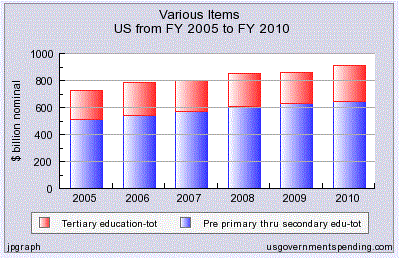
There is little doubt that on a national scale education spending isn't the magic that some think it is. The U.S. governments spend about $ 1 Trillion on education now after ramping up the funding over a period when student achievement has only gone downhill. Most of it is spent on K-12. The U.S. spends  more than almost every other country on earth, beat only by Switzerland. All that increased spending didn't all go do the richest districts, although they were preferred they're also too few to consume all that extra spending.


I believe that many impressions people have of how dry the education budgets are in the U.S. come two places. One is a lot of political zealots manipulating data by citing only federal expenditure when states and local governments are the main spenders. The seconds is the anecdotal stereotypical "budget cuts" that are immediately accepted without so much as a whiff of skepticism. How do you know that there are budget cuts? Who did you hear this from? Does "budget cut" mean what we think it means? (The term is often used to describe the difference between what the district asked for and how much they got, rather than the difference between what they got and what they got last year. Bullshit, I know)